So, you want to find out how to start exercising when you’re not motivated to do it at all. I know that feeling well.
The simple truth is, that’s a heavy lift. And I’m not talking about the barbell. Most days the heaviest lift is our own asses off the couch.
I’ve been there, especially after cancer treatment in 2025, when my energy showed up late (if it showed up at all). I’ve had days where my “workout” was walking to the mailbox and back. Some days, the mailbox wins. It happens.
So if you’re reading this because you feel unmotivated, flat, or annoyed that your brain won’t cooperate, you don’t owe me or anyone else an apology for being human. You haven’t lost points. You aren’t “off track.” You’re just at a red light, and the light always changes eventually.
Here’s the promise: I’m going to show you how to get motivated to exercise without hype, guilt, or perfect mornings. We’ll use simple systems that work on real-life days, including the 2-out-of-10 days. Most importantly, we’ll stop waiting for motivation to arrive first.
Why motivation to exercise disappears (and why it is normal)

When motivation vanishes, it’s easy to assume something is wrong with you. Usually, something is wrong with your inputs, not your character.
Real life drains motivation fast: poor sleep, work stress, relationship stuff, caregiving, money stress, chronic pain, and that fun combo platter of anxiety plus doomscrolling. On top of that, some of us have old injuries that flare up like a car alarm at 2 a.m. Others have bad gym memories, shame-based PE classes, or an “all-or-nothing” brain that says, “If I can’t do a full hour, why bother?”
I treat motivation like a check engine light. When it comes on, I don’t punch the dashboard and scream “discipline.” I ask, “What’s actually going on under the hood?” Sometimes the answer is simple: you’re tired. Sometimes it’s heavier: you’re burned out, depressed, or dealing with pain you’ve been ignoring.
A big trap is thinking a break erased your progress. It didn’t. Bodies don’t forget everything in a week. You’re not starting from zero, you’re starting from experience.
If you want a few practical reminders from an evidence-based source (without the influencer yelling), the National Institute on Aging has a solid page on tips to stay motivated to exercise. It’s written for real humans, not fitness robots.
Motivation is not the starting line, it is the reward for showing up
Motivation usually shows up after action, not before it. That’s the loop.
I do something small, I feel slightly better (or at least less stuck), then I’m more willing to do it again. Over time, that becomes momentum.
Here’s a simple example from my own “lower the bar” seasons:
I started with a 2-minute walk. Not a power walk, not a “steps goal,” just a lap to prove I could. A week later, it became 5 minutes. Then 10. The win wasn’t intensity, it was showing up when my brain tried to negotiate me into the couch.
Consistency beats intensity, especially on those days you rate as a 2 out of 10. On those days, the goal is not to impress anyone. The goal is to stay in the habit of being the kind of person who moves.
If you can only do the minimum today, do it with pride. Minimum keeps the chain unbroken.
Are you tired, stressed, or stuck, a quick self-check before you push
Before I “force” a workout, I run a quick check. It keeps me from turning exercise into punishment.
Here’s the decision guide I use. It’s not fancy, but neither was my first cell phone.
| What’s going on? | Green-light choice | What I avoid |
|---|---|---|
| Sick, fever, chest symptoms, or wiped out from no sleep | Rest, short walk, gentle mobility | Hard intervals, heavy lifting |
| High stress, anxious, overstimulated | Easy walk, zone-2 cardio, yoga, breathing plus movement | “Destroy yourself” workouts |
| Stuck, bored, low drive | Lower the bar, 10-minute start, tiny strength circuit | Waiting for inspiration |
Also, a quick reality note: if you have new chest pain, fainting, severe shortness of breath, or dizziness that feels wrong, a medical professional is smarter than grit. Same goes for injury pain that worsens as you move.
If low mood or anxiety is part of the problem, I keep this Mayo Clinic piece bookmarked because it’s practical and grounded: exercise for depression and anxiety symptoms. Sometimes the first “workout” is simply doing something that takes the edge off.
How I start working out when I don’t feel like it
This is the part I wish someone had handed me years ago on a sticky note.
When I’m tired and unmotivated, I don’t ask, “How do I feel?” I ask, “How can I make this easier to start?” Because starting is the whole battle.
If you’re wondering how to start working out when unmotivated, here’s my simple plan: reduce friction, commit to a tiny first step, and let the day be imperfect. That’s it. That’s the secret sauce. No shouting at yourself in a mirror required.
Use the 10 minute rule, I only have to start, not finish
I commit to 10 minutes. Then I give myself full permission to stop.
No guilt. No “I’m lazy” self-talk. If I stop after 10, I still win, because I kept the habit alive.
Most days, something funny happens around minute eight. My joints warm up. My mood shifts a notch. The workout stops feeling like a chore. Not always, but often enough that I trust the process.
A 10-minute start can look like:
- A walk outside (even around the block)
- A mobility flow on the living room floor
- Light dumbbells, slow and controlled
- A beginner video where someone else does the thinking
If you need proof that short sessions can count, this GoodRx article explains why 10-minute mini-workouts can be effective. I’m not married to any one format. I’m loyal to what gets me moving.
Make the first step stupid easy, set out clothes, shrink the workout, remove decisions
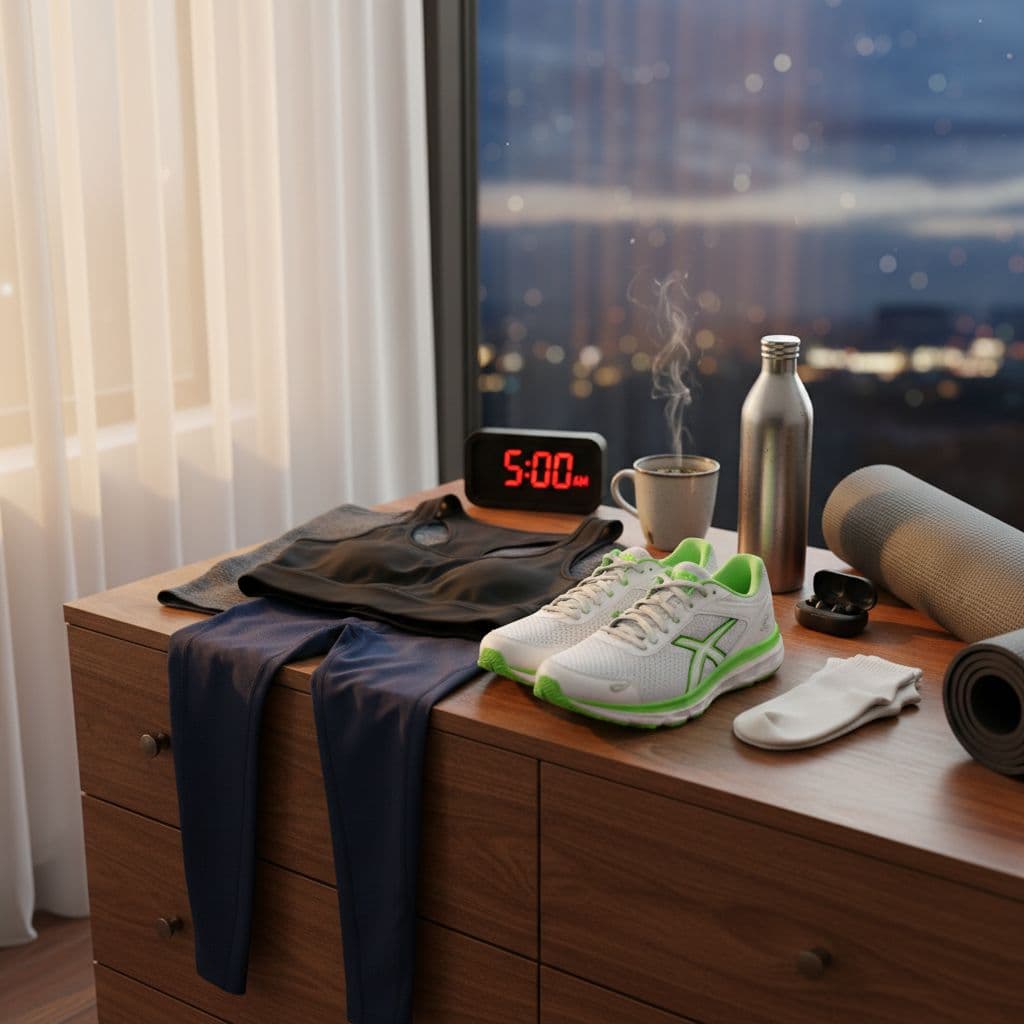
On low-energy days, decision fatigue is the real boss battle. If my workout requires 14 choices, I’m out. My brain is still loading like dial-up internet in 1999, and it’s making that horrible screeching sound.
So I remove choices ahead of time. I want fewer clicks.
Here are friction killers that actually work for me:
- Set out clothes and shoes the night before, like I’m a kid laying out school stuff.
- Pick the workout in advance, even if it’s “walk 10 minutes.”
- Keep equipment visible, bands on a doorknob, dumbbells near the couch.
- Use a short playlist (8 to 12 minutes) so I don’t scroll for 20 minutes.
- Drive to the gym and allow leaving after 5 minutes, because showing up is the win.
- Do a tiny circuit while coffee brews, squats to a chair, wall push-ups, gentle hinges.
The point is to make starting feel almost automatic. Motivation hates complicated. Momentum likes simple.
Build motivation that lasts by making exercise feel doable and worth it
Quick-start tricks get you moving today. Still, long-term motivation comes from something more boring and more powerful: a plan you can repeat without drama.
I’m not chasing “summer body” energy. I’m chasing longevity, mental clarity, and the ability to handle life without my back seizing up when I load groceries.
That means I build a routine that survives bad weeks, travel, stress, and those random Tuesdays that arrive like a flat tire.
Choose workouts you can repeat on a bad week, not workouts that impress strangers
If a plan only works when everything is perfect, it’s not a plan. It’s a fantasy.
A simple “minimum effective” routine for many adults looks like this:
- Strength training 2 to 3 days a week (full-body, basics)
- Walking most days (even short walks count)
- Mobility sprinkled in (5 minutes is fine)
Busy parent version: 15 to 25 minutes, twice a week for strength, plus walks when you can. Busy professional version: split sessions into two short blocks (10 minutes at lunch, 10 minutes after work). Same total work, less mental resistance.
If you’re newer, older, coming back from a health scare, or dealing with pain, government health guidance can help you keep it safe and sane. The NIDDK has a straightforward page on tips for starting physical activity that matches the “start small, build slow” approach.
What matters most is that you finish the week thinking, “I can do that again,” not “I need a week to recover from my workout.”
Track the wins that matter, energy, mood, sleep, and pain levels
I’m not against tracking weight or reps, but it’s not my main scoreboard anymore. My real scoreboard is: do I feel more capable?
I keep tracking simple. If it feels like homework, I won’t do it.
A few low-effort options:
- A checkmark on a wall calendar
- A note in my phone that says “Walked, felt calmer after”
- A weekly reminder that asks, “What helped? What got in the way?”
I also track “after effects” like sleep, mood, and nagging pain. That data helps me choose workouts that build me up instead of beating me down.
And yes, I celebrate tiny wins. Matching socks. Put on shoes. Did 10 minutes. Didn’t overthink it. That’s not corny, that’s how habits form.
When I keep falling off, how I restart without the shame spiral
Most people don’t “fail” at exercise. They stop, then they punish themselves for stopping, then they wait until they feel worthy to restart. That middle part is the problem.
Life will interrupt you. Illness, travel, deadlines, family stuff, injuries, mental health dips. That’s not a character flaw, that’s a calendar.
The goal isn’t perfection. The goal is having a restart button you actually press.
Use the red light reset, missed days are not failure, they are a pause
You don’t owe me or anyone else an apology for being human. You aren’t off track. You’re just at a red light. The light always changes eventually.
When I restart, I use a 3-step reset:
- Do 5 minutes today. Anything gentle counts, walk, mobility, light strength.
- Schedule the next session immediately. If it’s not scheduled, it’s a wish.
- Tell one person. A text is enough: “I’m back at it, tiny start.”
I also restart at about 70 percent of what I think I can do. That keeps soreness low and confidence high. Going too hard on day one is how I used to blow myself up, then disappear for two weeks.
If motivation is crushed by depression, burnout, or chronic pain, I change the plan
Sometimes “just do it” isn’t helpful. Sometimes it’s harmful.
If depression, burnout, or chronic pain is the reason you can’t get going, I lower the bar and widen the definition of training. I also consider getting support from a clinician or therapist, because health is a team sport.
On hard seasons, options that often work better include:
- Chair workouts or supported strength moves
- Water walking or easy swimming (great for joints)
- Resistance bands instead of heavy weights
- Short mobility flows and gentle stretching
- Extra sleep and stress reduction as the “workout”
Lighter is still training. In fact, it can be the smartest kind, especially if your goal is staying mobile and independent for decades.
How To Get Motivated To Exercise: Conclusion
Motivation is unreliable. Systems are reliable. When I stop treating exercise like a personality test and start treating it like brushing my teeth, it gets easier to show up.
If you want one simple next step, do this today: pick a 10-minute session, lay out your clothes, schedule it, and text a friend. Keep it small enough that your brain can’t argue.
If you want structure without the boot camp energy, a beginner-friendly follow-along program (I use BODi for this) can remove a lot of decisions. I’m not saying it’ll turn you into a superhero. It’s just nice when someone else plans the workout and you just press play.
Above all, choose self-respect over self-criticism. Also, if you put on your socks without making a weird noise, you’re already ahead of the curve.